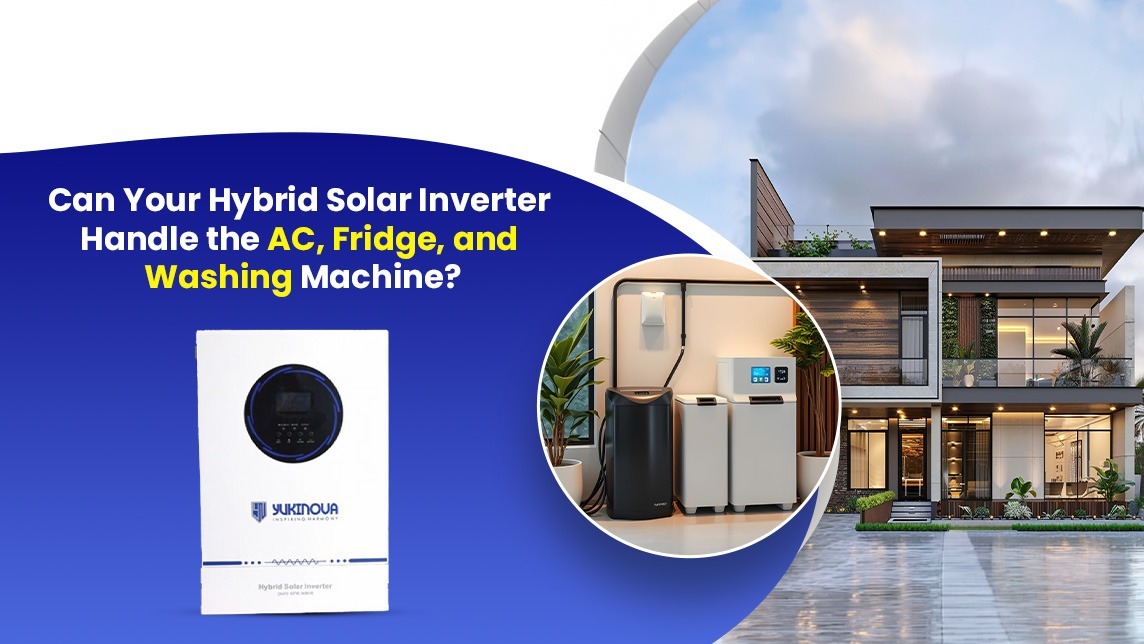
Can Your Hybrid Solar Inverter Handle the AC, Fridge, and Washing Machine?

Power cuts show up exactly when you need power the most. And suddenly everyone around you seems to be talking about solar. So the obvious question hits you. Can one of these Hybrid Solar Inverter systems actually run the big stuff? Your AC that you desperately need in summer. The fridge that hums away constantly. That washing machine you absolutely cannot live without.

Quick answer? Yes it can.

What is a Hybrid Solar Inverter?

The solar panels sit on the roof making electricity when the sun’s doing its thing. That power needs to go somewhere useful.

A hybrid solar inverter takes that solar power and uses it to run your house first. Whatever power is left after usage is stored in batteries for later. And if somehow solar isn’t making enough, like at night or during monsoon, the system just pulls from the electricity grid.

That switching between three different sources happens automatically. No buttons to press. No complicated settings. It just figures it out. That flexibility is why people prefer hybrid solar inverter setups these days.

1. AC

ACs are monsters when it comes to power. A one ton AC pulls around 1000 watts. Got a 1.5 ton unit? That’s pushing 1800 watts or even more during peak summer.

Now if your inverter is too small, it’s going to struggle. Might even shut down to protect itself. But if you sized it right, the AC runs smooth without drama.

Running one AC plus your normal stuff like fans and lights? You might need somewhere between 3 kilowatts to 5 kilowatts from your hybrid solar inverter.

And here’s the thing nobody mentions enough. If you want a long backup during those endless power cuts, battery size matters way more than people realize. A small battery with a big AC? Gets drained super fast.

2. Fridges

Here’s some good news for once.

Fridges don’t constantly eat power like you might think. Average pull is somewhere between 150 to 400 watts depending on the model.

There’s a small spike when the compressor starts up, but any decent inverter handles that spike without breaking a sweat.

Even a medium sized hybrid solar inverter runs a fridge easily. One less thing to worry about.

3. Washing Machines

This one depends heavily on what type you’ve got.

Semi automatic machines use way less power. Maybe 300 to 500 watts. Fully automatic ones especially the ones with built in heaters? Those can spike up to 2000 watts when they’re heating water for that hot wash cycle.

Here’s where people mess up. They try running an AC and a washing machine at the same time without checking if their system can handle both loads stacked together. Then things trip or shut down.

Load calculation sounds boring but skipping it causes actual problems later.

What Actually Matters When You’re Choosing

Here’s what you really need to look at: How many kilowatts your inverter can handle. How many kilowatt hours your battery stores. What your total home load actually is. How many hours of backup you actually want when power goes out.

Let’s say everything you want to run at once adds up to 4000 watts. Your inverter should handle that comfortably. Systems running at their absolute limit all the time don’t last long.

Good quality Hybrid Solar Inverter units also deal with those annoying power spikes when appliances first turn on. Makes everything run smoother overall instead of lights dimming every time the fridge compressor kicks in.

So Does It Work or Not?

Can you run an AC, fridge, and washing machine together on a hybrid solar inverter? Absolutely yes.

But sizing matters more than anything else. Bigger appliances need proper planning upfront. Get the system designed correctly from the start and you end up with lower monthly bills and reliable backup whenever the grid decides to take a break.

Ready to power your AC, fridge, and washing machine without worrying about rising bills or sudden outages? Upgrade to the Yukinova Solar Hybrid Inverter and get a system that’s smartly designed and built to handle your real home load.

FAQs

Q. Can AC run during power cuts on hybrid solar setup?

Yep, as long as your battery has enough juice stored up to handle it.

Q. How long will the battery keep my AC running?

Depends completely on battery size and how much power your AC pulls. Bigger battery, bigger AC, you do the math.

Q. Is 3 kilowatt inverter enough for heavy stuff?

For one AC plus basic home load maybe yeah. Want to run more? You probably need 5 kilowatts or higher.

Q. Does the fridge eat up too much solar power?

Nah. Uses moderate power and cycles on and off. Not a problem really.

Q. Does hybrid solar work for smaller homes too?

Sure does. Just needs to be sized correctly for what you’re actually running. Small home doesn’t automatically mean a small system if you’ve got big appliances.
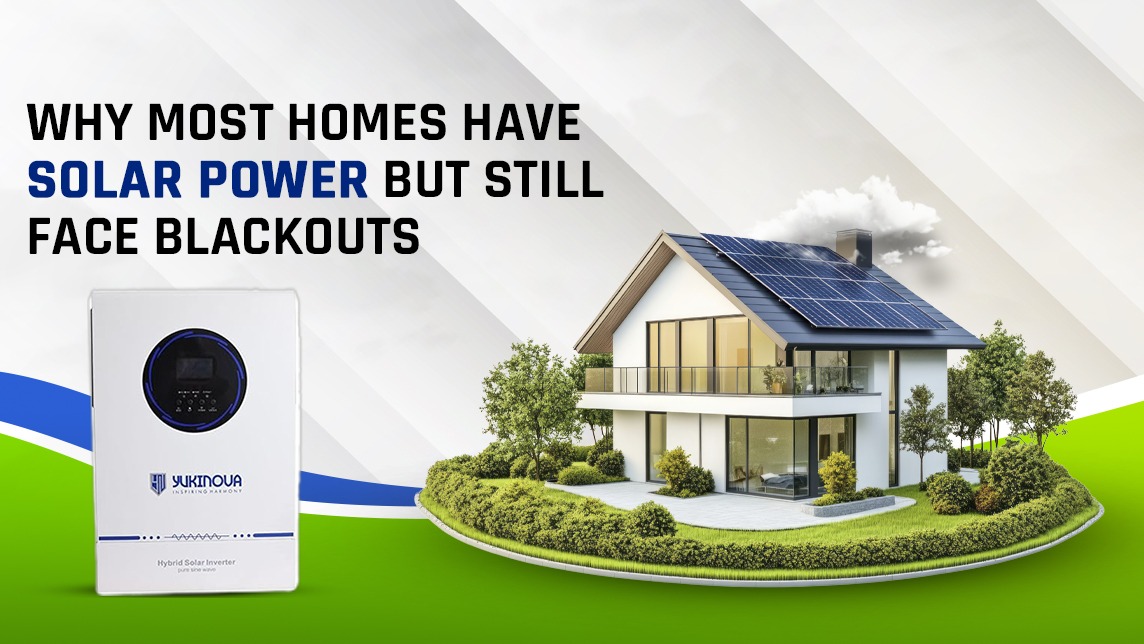
Why Most Homes Have Solar Power but Still Face Blackouts

At surface level, a solar-powered home should never go dark. Panels generate electricity, sunlight is free, and energy bills drop steadily. Yet blackouts still occur, often without warning. This situation frustrates homeowners because the issue feels illogical. In reality, the problem rarely comes from solar power itself. Instead, it results from how most residential systems are planned, connected, and controlled. Yukinova Hybrid solar inverter comes with the perfect solution to this frustrating situation.

In this blog, let’s figure out why most homes in spite of having solar power face blackout.

Solar Adoption Without Backup Thinking

Most homes adopt solar to reduce electricity costs, not to secure backup power. Because of this focus, installers usually connect panels directly to the grid. When the grid fails, the solar system shuts down immediately. This shutdown protects infrastructure and workers, but it also leaves homes without power. Therefore, solar installation alone does not guarantee continuity. Without a hybrid solar inverter, solar energy cannot support essential loads during outages.

Why Energy Storage Defines Reliability

Solar panels produce electricity during daylight hours. However, households consume power throughout the day and night. When systems lack storage, excess energy flows back to the grid and becomes unavailable locally. As a result, homes remain dependent on external supply. A hybrid solar inverter changes this balance by storing usable energy and releasing it precisely when grid power is unavailable.

System Design Gaps Create Blackouts

Many installations prioritize panel capacity while overlooking actual energy behavior. High-load appliances demand stable surge handling, especially during transitions. Poorly matched systems struggle under these conditions. Even when batteries are present, inefficient power management limits performance. Here, intelligent system architecture becomes essential. A hybrid solar inverter coordinates solar input, battery discharge, and grid interaction smoothly, reducing stress and preventing failure points.

The Role of Energy Density in Backup Power

Backup duration depends heavily on energy density. Low-density systems exhaust power quickly, regardless of battery size. Yukinova addresses this limitation through refined engineering. With optimized design, Yukinova systems deliver four to five times higher usable efficiency compared to conventional setups. This improvement allows for longer backup duration, stronger output stability, and consistent performance during extended outages.

Why Yukinova Delivers Consistent Power

Yukinova treats reliability as a core design requirement, not an optional feature. Every hybrid solar inverter undergoes controlled testing for voltage stability, load variation, and transition accuracy. As a result, homes experience smooth power continuity even when grid conditions fluctuate unexpectedly.

Financial Value Beyond Electricity Savings

Blackouts impose indirect costs such as appliance damage, work disruption, and daily inconvenience. Although solar systems reduce monthly bills, unreliable performance reduces overall value. Yukinova systems protect routines while optimizing energy usage. Over time, homeowners gain not only financial efficiency but also operational confidence through a dependable hybrid solar inverter solution.

Building Practical Energy Independence

True energy independence requires more than rooftop panels. It requires storage intelligence, system balance, and future readiness. Yukinova solutions scale easily as energy demand grows. Through advanced design and intelligent control, Yukinova systems transform solar installations into dependable power infrastructure.

Conclusion

Solar power does not fail homes. Incomplete system planning does. Yukinova bridges this gap through engineered reliability, intelligent storage, and advanced hybrid solar inverter technology. With optimized design, Yukinova delivers uninterrupted power where standard systems consistently fall short.

Frequently Asked Questions

Q1. Why do solar homes face blackouts?

Most grid-connected systems shut down during outages due to safety requirements.

Q2. How does a hybrid solar inverter help?

It enables stored energy use during outages without grid dependency.

Q3. Why choose Yukinova systems?

Yukinova delivers engineered reliability, higher efficiency, and proven real-world performance.

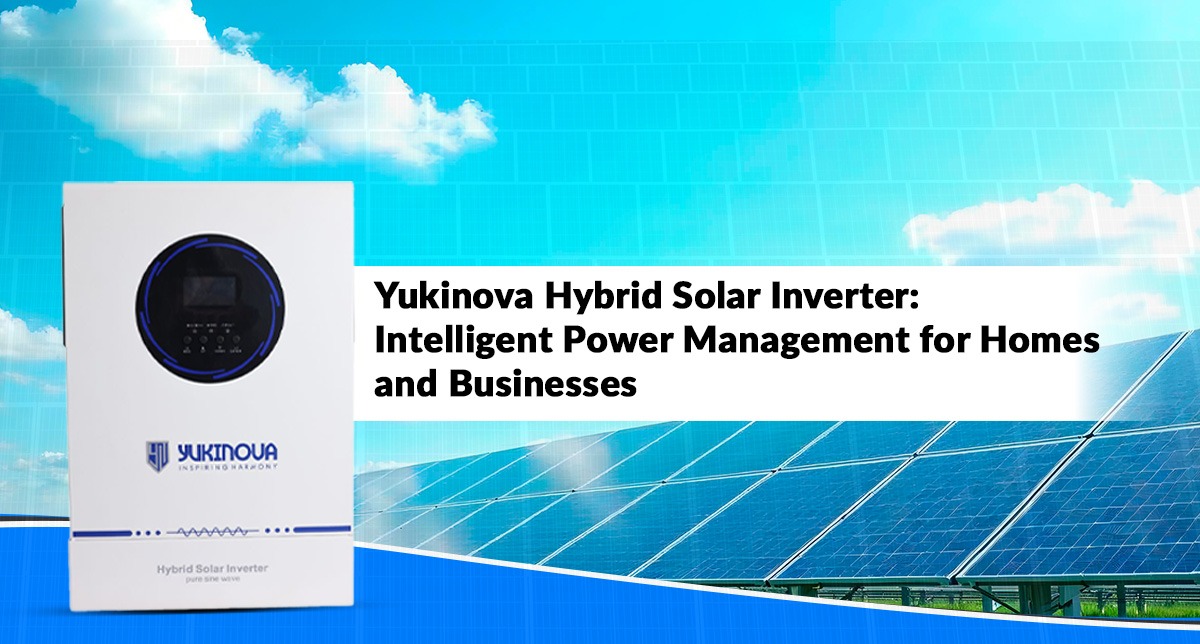
Yukinova Hybrid Solar Inverter: Intelligent Power Management for Homes and Businesses

Electric power has become deeply connected to daily living. When the supply is stable, everything moves smoothly. However, unexpected outages, and rising energy costs have made reliability difficult to depend on. In this situation, the need for a dependable and efficient energy solution becomes essential. This blog discusses why the Yukinova hybrid solar inverter stands out as a reliable energy solution designed to meet modern energy challenges.

Why choose Yukinova Hybrid Solar Inverter

1. Technology Designed for Practical Power Demands

Yukinova hybrid solar inverter draws power intelligently from solar panels, battery backup, and the main grid, ensuring balanced performance even when one source becomes weak. Instead of relying on manual actions, the system manages supply automatically. This monitors availability, prioritises solar power, and maintains steady output so essential loads remain stable and protected.

2. Intelligent Power Flow and Protection

Energy systems are expected to work silently, without trouble, and without constant attention. To support this expectation, the inverter offers structured power switching, efficient conversion, and a well-designed control system that reduces unnecessary losses. This contributes not only to improved energy utilisation but also to cost control in the long term.

Protection has also been given serious focus.
-Voltage fluctuations.
-Short circuit conditions.
 -Sudden surges.
All these can damage equipment if unmanaged, so the design includes multiple safety layers that help protect devices and maintain confidence in the system’s performance.

3. Suitable for Homes and Businesses

One of the most important strengths of this inverter is its adaptability across different usage environments. For homes, it supports continuous electricity. Thus helping families handle daily routines without the disruptions. For offices, shops, and small commercial units it helps maintain operations seamlessly.Thus preventing downtime and supporting smooth workflow, which is often critical for customer trust and service quality.

4. Easy Operation and Long-Term Reliability

Yukinova places strong emphasis on systems that are efficient yet practical to operate. Installation is planned to be straightforward, monitoring is user-friendly, and essential information remains accessible so users can understand performance clearly.
 Durability is a core system characteristic of this inverter. High-quality internal components, controlled manufacturing processes, and consistent testing contribute to dependable performance across years of use.
With this inverter, users are able to depend on long-term energy support rather than viewing it only as a short-term backup arrangement.

Yukinova hybrid solar inverter: A Dependable Choice for Modern Energy Requirements

Selecting an energy system today is not only about immediate performance. It is also about sustainability, and the reassurance that the system will continue supporting daily needs even in demanding conditions.
By combining dependable build quality and efficiency, Yukinova hybrid solar inverter stands as a strong and practical solution.

If you want to buy Yukinova hybrid solar inverter from amazon, you can click on the below links
https://www.amazon.in/dp/B0G4RQ9L8T?ref=cm_sw_r_cp_ud_dp_89RCW1PEDV9FRNNRMYQR&ref_=cm_sw_r_cp_ud_dp_89RCW1PEDV9FRNNRMYQR&social_share=cm_sw_r_cp_ud_dp_89RCW1PEDV9FRNNRMYQR

Buy our 4 kVA Range
https://www.amazon.in/dp/B0G3WBNYB9?ref=cm_sw_r_cp_ud_dp_FHJ0W233T9M4JJWWBG5J&ref_=cm_sw_r_cp_ud_dp_FHJ0W233T9M4JJWWBG5J&social_share=cm_sw_r_cp_ud_dp_FHJ0W233T9M4JJWWBG5J

Buy our 6.2 kVA Range
https://www.amazon.in/dp/B0G3P55KWQ?ref=cm_sw_r_cp_ud_dp_2BBZ7R0SWH0A26TWJCST&ref_=cm_sw_r_cp_ud_dp_2BBZ7R0SWH0A26TWJCST&social_share=cm_sw_r_cp_ud_dp_2BBZ7R0SWH0A26TWJCST

FAQs

Q.Is it compatible with multiple battery technologies?
 Yes, the system supports different battery options based on application requirements.

Q.Is it appropriate for commercial environments as well as homes?
 Yes, it performs effectively for residential, business, and institutional usage conditions.

Q.Does it require frequent maintenance?
 No, routine inspection is generally sufficient as the system is designed for long-term stable operation.