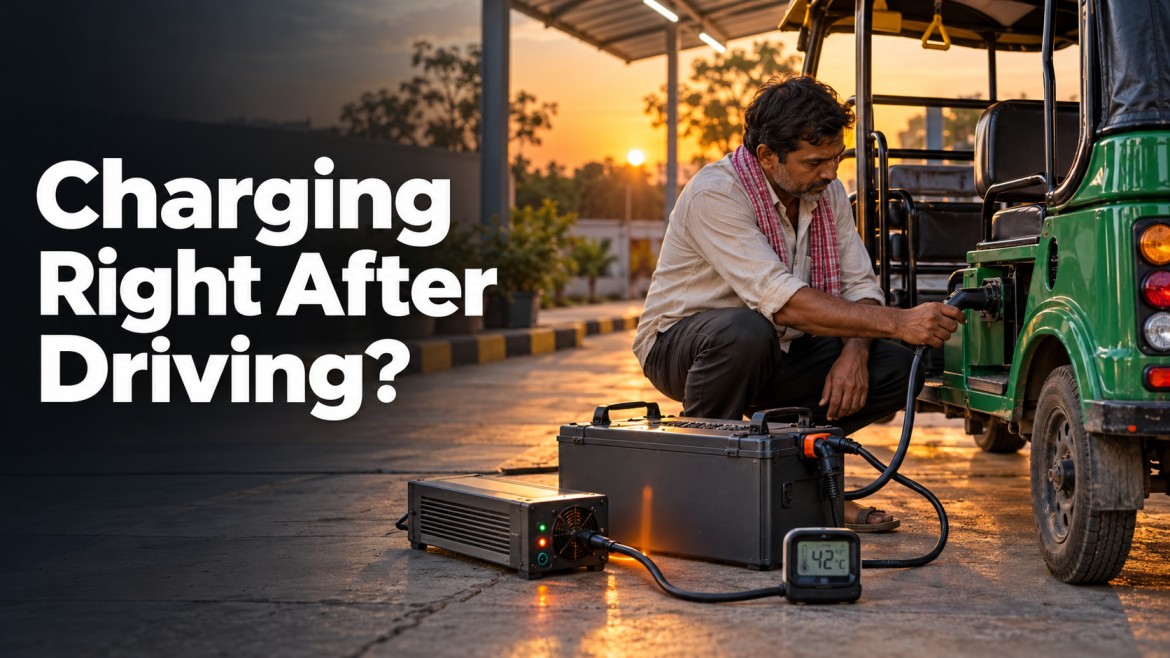
At the end of his shift, an e-rickshaw driver plugs his vehicle in to charge and then hooks up the battery charger. It is certainly part of his routine at the end of the day to be ready for the next day.
But have you ever wondered what’s happening inside that battery after he’s driven all day?
A battery that’s been working all day may still be warm. Plugging it in to charge may add more heat, depending on its condition and the charging system.
It is important for e-rickshaw drivers, operators of e-rickshaw fleets, and persons buying Lithium-Ion Three Wheeler Batteries from a manufacturer to understand this.
Why Does an E-Rickshaw Battery Become Warm During Driving?
An e-rickshaw battery provides a continuous supply of electricity to the motor. Higher currents are drawn by the battery during acceleration, uphill movement and with heavier passenger loads.
This can cause the battery to heat up.
Other conditions that can cause the battery to heat up include:
- Continuously driving for several hours
- Carrying heavy passenger loads
- Driving in hot summer weather
- Doing a lot of starting and stopping
- Driving on roads that are not even and have a lot of ups and downs
Normal temperature increase is to be expected. Too much heat can affect the performance of the battery in a negative way.
What Happens When You Start Charging Immediately?
When the charger is plugged in, the energy in the charger starts flowing to the battery as long as the battery management system lets it.
Charging creates heat. During a long and hard day of work, a battery may get hot. Adding more heat to it by charging may further increase its temperature.
Lithium battery packs have a Battery Management System (BMS) that checks important operating conditions of the pack.
Depending on the design of the BMS, it may limit the charging current or stop charging altogether to maintain safe operating conditions of the battery pack.
Thus, proper e rickshaw battery charging is condition-based and dependent on charging recommendations of the manufacturer.
Can Immediate Charging Reduce Battery Life?
Charging right after driving does not damage lithium-ion batteries. Rather, it’s charging at a high temperature that is problematic.
Exposure to high temperatures can induce aging of the materials within lithium-ion batteries. As this occurs over the life of the battery, it can result in a shorter battery life and reduced capacity.
For example, a battery in an e-rickshaw operating in the intense heat of the afternoon can come back with a warmer battery than one used in the cool morning hours.
Both batteries may require charging, but they may have experienced different temperatures.
A responsible Lithium Ion Three Wheeler Battery Manufacturer takes into consideration the impact of charging on the battery system and provides a thermal protection mechanism to address it.
Why Is the Battery Management System Important?
A Battery Management System (BMS) helps manage safety for a lithium battery. BMS takes reading of battery voltage, current and temperature to avert unsafe conditions. Depending on the design of the battery, a BMS may offer protection against overcharging, over-discharge, over current and over temperature.
A BMS is not a replacement for proper battery charging practices. Safety threats may still exist from use of incorrect charger, blocking ventilation and charging a damaged battery.
Drivers should always follow the instructions supplied by the battery and charger manufacturers.
Should You Wait Before Charging After a Long Shift?
There is no standard time period for waiting for lithium-ion e-rickshaw batteries.
If the battery is in the permissible charging temperature range it can be charged.
If the battery is very hot to the touch or shows a high temperature warning, the manufacturer recommends waiting for the battery to cool down naturally before attempting to charge it.
The battery can be cooled with water or other techniques such as a direct spray cooler to reduce the temperature of the battery. This is not safe and should be avoided.
For daily use, try to park the vehicle in a shaded and ventilated location to prevent the battery from overheating.
Practical Charging Habits for E-Rickshaw Drivers
Having good charging habits can increase your battery’s performance and lifespan.
As a general charging rule, you should always use a charger designed and manufactured by the battery manufacturer. Inspect charging cables and connectors for damage often.
You should always charge your battery in a well-ventilated area away from anything flammable.
If your battery gets extremely hot or swollen, releases smoke or odor of any kind, contact your battery manufacturer or related service/repair professional, and disconnect from the charger and power source if it is safe to do so.
Fleet operators should check charging behavior to identify problem charging behavior.
Choosing a Reliable Lithium Battery for Three Wheelers
For drivers who earn their income by the day with their vehicle, battery performance is very crucial.
When choosing a Lithium Ion Three Wheeler Battery Manufacturer, buyers should look into battery capacity, BMS protection, charger compatibility, warranty and service conditions.
Yukinova can provide battery solutions for the electric mobility sector. Before installation, customers should confirm the specifications of the chosen battery and check the charging needs of the battery.
A proper battery along with safe and correct charging practices will provide a good solution for dependable daily operations of e-rickshaws.
Frequently Asked Questions (FAQs)
1. Can I charge my e-rickshaw battery immediately after driving?
Yes, provided the battery temperature is within the manufacturer’s approved charging range. If the battery is unusually hot, allow it to cool according to the manufacturer’s guidelines.
2. Does battery temperature affect lithium-ion charging?
Yes. Excessively high or low temperatures can affect charging efficiency, battery ageing, and safety. Some battery management systems restrict charging outside permitted temperature limits.
3. How long should an e-rickshaw battery cool before charging?
There is no fixed cooling time for every battery. Follow the manufacturer’s instructions and wait until the battery reaches its permitted charging temperature range.
4. Can charging a hot battery reduce its lifespan?
Repeated charging at elevated temperatures can accelerate lithium-ion battery degradation, potentially reducing capacity and useful service life.
5. What is the role of a BMS in lithium battery safety?
A Battery Management System monitors parameters such as voltage, current, and temperature. It can restrict or disconnect charging when unsafe conditions are detected, depending on its design.
6. How can drivers improve e-rickshaw battery charging performance?
Use a compatible charger, avoid excessive heat, maintain clean connectors, follow recommended charging practices, and arrange professional inspection when charging problems occur.