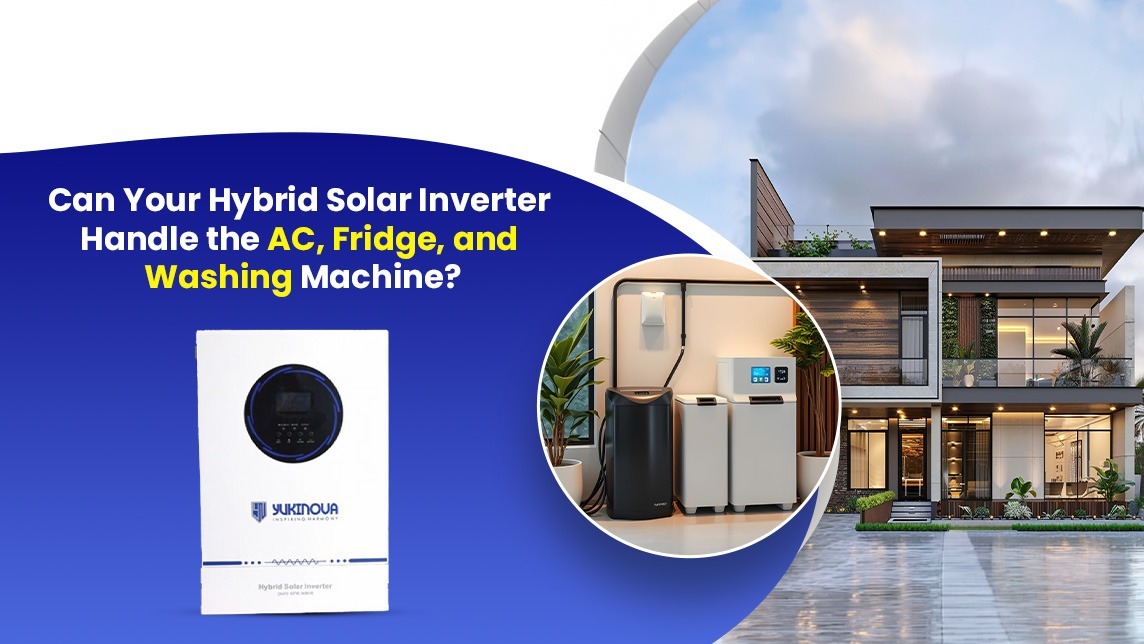
Can Your Hybrid Solar Inverter Handle the AC, Fridge, and Washing Machine?

Power cuts show up exactly when you need power the most. And suddenly everyone around you seems to be talking about solar. So the obvious question hits you. Can one of these Hybrid Solar Inverter systems actually run the big stuff? Your AC that you desperately need in summer. The fridge that hums away constantly. That washing machine you absolutely cannot live without.

Quick answer? Yes it can.

What is a Hybrid Solar Inverter?

The solar panels sit on the roof making electricity when the sun’s doing its thing. That power needs to go somewhere useful.

A hybrid solar inverter takes that solar power and uses it to run your house first. Whatever power is left after usage is stored in batteries for later. And if somehow solar isn’t making enough, like at night or during monsoon, the system just pulls from the electricity grid.

That switching between three different sources happens automatically. No buttons to press. No complicated settings. It just figures it out. That flexibility is why people prefer hybrid solar inverter setups these days.

1. AC

ACs are monsters when it comes to power. A one ton AC pulls around 1000 watts. Got a 1.5 ton unit? That’s pushing 1800 watts or even more during peak summer.

Now if your inverter is too small, it’s going to struggle. Might even shut down to protect itself. But if you sized it right, the AC runs smooth without drama.

Running one AC plus your normal stuff like fans and lights? You might need somewhere between 3 kilowatts to 5 kilowatts from your hybrid solar inverter.

And here’s the thing nobody mentions enough. If you want a long backup during those endless power cuts, battery size matters way more than people realize. A small battery with a big AC? Gets drained super fast.

2. Fridges

Here’s some good news for once.

Fridges don’t constantly eat power like you might think. Average pull is somewhere between 150 to 400 watts depending on the model.

There’s a small spike when the compressor starts up, but any decent inverter handles that spike without breaking a sweat.

Even a medium sized hybrid solar inverter runs a fridge easily. One less thing to worry about.

3. Washing Machines

This one depends heavily on what type you’ve got.

Semi automatic machines use way less power. Maybe 300 to 500 watts. Fully automatic ones especially the ones with built in heaters? Those can spike up to 2000 watts when they’re heating water for that hot wash cycle.

Here’s where people mess up. They try running an AC and a washing machine at the same time without checking if their system can handle both loads stacked together. Then things trip or shut down.

Load calculation sounds boring but skipping it causes actual problems later.

What Actually Matters When You’re Choosing

Here’s what you really need to look at: How many kilowatts your inverter can handle. How many kilowatt hours your battery stores. What your total home load actually is. How many hours of backup you actually want when power goes out.

Let’s say everything you want to run at once adds up to 4000 watts. Your inverter should handle that comfortably. Systems running at their absolute limit all the time don’t last long.

Good quality Hybrid Solar Inverter units also deal with those annoying power spikes when appliances first turn on. Makes everything run smoother overall instead of lights dimming every time the fridge compressor kicks in.

So Does It Work or Not?

Can you run an AC, fridge, and washing machine together on a hybrid solar inverter? Absolutely yes.

But sizing matters more than anything else. Bigger appliances need proper planning upfront. Get the system designed correctly from the start and you end up with lower monthly bills and reliable backup whenever the grid decides to take a break.

Ready to power your AC, fridge, and washing machine without worrying about rising bills or sudden outages? Upgrade to the Yukinova Solar Hybrid Inverter and get a system that’s smartly designed and built to handle your real home load.

FAQs

Q. Can AC run during power cuts on hybrid solar setup?

Yep, as long as your battery has enough juice stored up to handle it.

Q. How long will the battery keep my AC running?

Depends completely on battery size and how much power your AC pulls. Bigger battery, bigger AC, you do the math.

Q. Is 3 kilowatt inverter enough for heavy stuff?

For one AC plus basic home load maybe yeah. Want to run more? You probably need 5 kilowatts or higher.

Q. Does the fridge eat up too much solar power?

Nah. Uses moderate power and cycles on and off. Not a problem really.

Q. Does hybrid solar work for smaller homes too?

Sure does. Just needs to be sized correctly for what you’re actually running. Small home doesn’t automatically mean a small system if you’ve got big appliances.
Mistakes Customers Make While Buying Inverters and Batteries

Most inverter and battery problems do not begin after installation. They begin at the buying stage. When purchases are made in urgency rather than careful consideration. These rushed decisions will cause long term performance issues. This is especially the case when the lithium battery is selected based on assumptions and not actual facts.

Many people will rely on random suggestions, price comparisons and word of mouth instead of evaluating how much power is actually needed in their homes. And soon this gap between your assumption and reality become obvious when backup becomes inconsistent and battery wears faster

1. Mistaking Higher Capacity for Better Backup

One of the most common mistakes involves capacity selection. Many customers assume that a higher Ah rating automatically guarantees longer backup. In reality, capacity works only when matched correctly to the connected load.

When appliances draw power unevenly, batteries discharge faster than expected. Consequently, even large systems feel inadequate. Customers who calculate actual usage before buying experience far more reliable performance, regardless of battery size.

For example, many households choose a higher capacity battery assuming it will support all appliances during outages. However, when lights, fans, a refrigerator, and occasionally high load appliances run together without planning, backup time drops sharply. The issue is not battery size, it is unrealistic load expectation.

2. Ignoring Daily Power Usage Patterns

Not all power cuts behave the same way. Some households face frequent short outages. Others experience long evening interruptions. However, many buyers ignore this distinction entirely during inverter battery buying decisions.

A lithium battery for inverter performs best when usage patterns align with its operating design. Frequent deep discharges without structured recharging reduce efficiency over time. Therefore, understanding how and when power gets used matters as much as the technology itself.

3. Overlooking Installation Environment

Installation conditions rarely receive attention while choosing the right inverter battery. Batteries often end up placed in tight corners, poorly ventilated rooms, or areas exposed to heat. Over time, these conditions quietly reduce efficiency.

Lithium inverter battery systems handle energy efficiently, but heat buildup still affects internal balance. Proper airflow and correct placement preserve performance without any additional investment. This detail often separates long lasting systems from disappointing ones.

4. Letting Price Decide Everything

Price comparison feels logical at the buying stage. However, price only decisions often lead to regret later. Customers sometimes compromise on quality to reduce upfront cost. As a result, maintenance expenses increase over time.

Long term reliability always proves more valuable than short-term savings, especially for systems expected to perform daily during power interruptions.

5. Assuming Technology Eliminates User Responsibility

Advanced technology simplifies operation, but it does not remove responsibility. Many buyers believe lithium systems require no attention. This belief leads to careless load management and irregular charging habits.

Lithium battery for inverter solutions deliver excellent efficiency. However, proper charging routines and sensible load distribution remain essential. When users engage responsibly, performance stays predictable and consistent.

Why Informed Buying Changes Everything

Yukinova designs lithium batteries for inverter solutions around real household usage conditions, not just brochure specifications. When buying decisions are informed by actual load, usage timing, and environment, systems perform the way users expect them to.

Customers who buy with clarity experience fewer surprises. They plan loads. They respect operating guidelines. As a result, backup performance remains steady rather than inconsistent.

Conclusion: Reliability Begins at the Decision Stage

Most inverter and battery problems begin at the purchase stage, not years later. Mistakes made early shape performance for the entire life cycle.

Lithium battery for inverter technology offers excellent efficiency and longevity. Yet, its value appears only when customers choose wisely. Yukinova combines reliable engineering with practical guidance ensuring power backup performs reliably because the right decisions were made at the buying stage.

Understand how choosing the right lithium battery for inverter and planning usage correctly improves long-term backup performance in Indian homes.

FAQs

Q1. What is the most common mistake while buying an inverter battery?

Ignoring actual load requirements and daily usage patterns.

Q2. Is lithium battery for inverter suitable for Indian homes?

Yes, when selected correctly and used according to real power conditions.

Q3. How does Yukinova support long-term reliability?

Yukinova designs systems for real usage conditions and guides customers toward informed buying decisions.