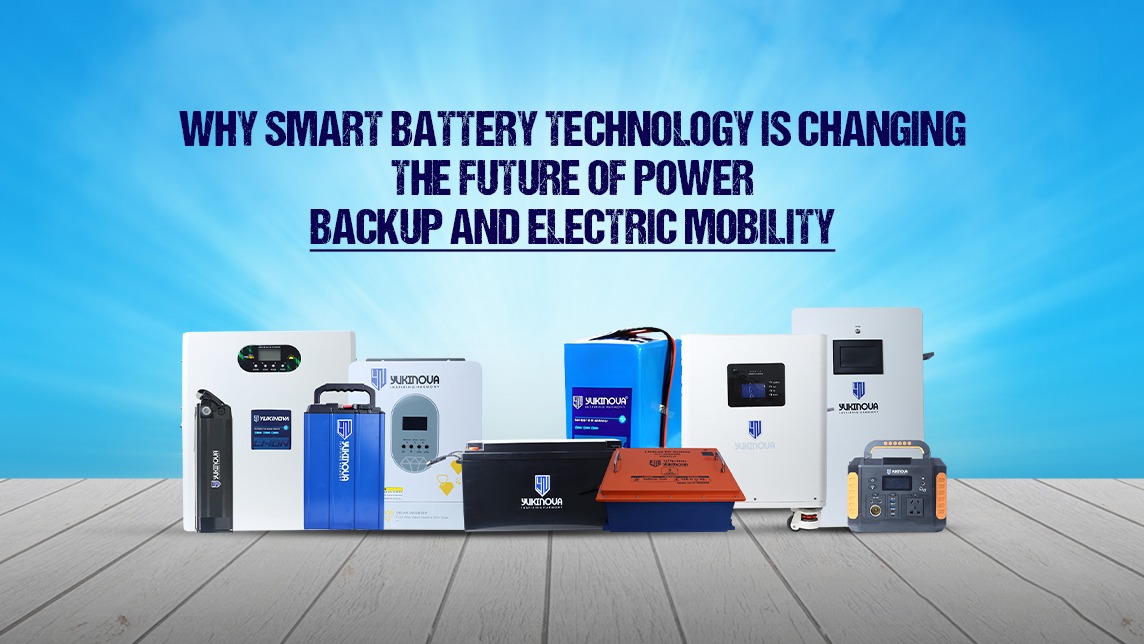
Advances in battery technology have been taking place very rapidly. Just a few years back, customers were primarily concerned about battery life and their recharge speed. However, today, all these expectations have dramatically changed, and people expect their batteries to be smart, secure, fast, and reliable. This change in expectations will inevitably propel the lithium battery manufacturing sector towards a new technology paradigm that can be referred to as smart battery technology.
In whatever form the modern Lithium Ion Battery takes – be it for an electric scooter, an inverter setup, a portable power station, or even a commercial electric vehicle, this type of a battery no longer represents just an energy reservoir. These batteries are becoming smart units that not only monitor themselves but also optimize power consumption and ensure greater safety.
The Problem with Traditional Battery Systems
Conventional battery systems function quite simply. They accumulate power, provide power supply, and wear out gradually. Most consumers tend to take note of battery problems only when backup has been severely reduced, or the battery fails to function entirely.
This problem causes many difficulties to users. The charge is not always stable, its performance reduces, and it requires additional investments for maintenance. In case of using the battery in commercial purposes, such as e-rickshaws and delivery trucks, failure of the battery directly affects income level.
The outdated batteries have poor cooling capacities, and their charges are also suboptimal. Excessive heating and incorrect charging considerably decrease the battery life cycle. However, modern lithium battery systems solve the problem effectively.
What Makes a Battery “Smart”?
Battery management technology revolves around the efficiency and control of energy inside a battery. Lithium batteries have state-of-the-art BMS that constantly track the status of a battery, the battery voltage, the temperature, the charging process, and even its performance levels.
Not only does this technology help maintain the battery by protecting it from damage, but it also helps to make it operate more efficiently.
A battery automatically controls its charging rate, voltage balance, and overheating when used heavily. This makes for not only a safer battery operation but also greatly extends the battery’s lifespan.
Why This Technology Matters for Electric Vehicles
The advent of electric vehicles is one of the key reasons behind the need for smart battery systems. The functioning of such vehicles as electric scooters, e-rickshaws, and three-wheelers depends upon battery efficiency. Any inefficiency, no matter how slight, can have a negative impact on the range of the vehicle as well as its overall productivity.
Modern battery systems that use lithium ions contribute to maintaining stability in power supply even when vehicles operate for prolonged periods of time. It also leads to increased efficiency in charging, thus reducing the amount of time necessary for charging.
For commercial vehicles, this becomes crucial since any down-time means lost money.
Smart Batteries Are Also Improving Power Backup Systems
It should be noted that smart battery technology affects not only electric cars but also inverter technology and power stations.
In today’s world, customers demand uninterruptible back-up, quick charge rates, and higher energy efficiency even during power shortages. Regular batteries tend to perform poorly during high loads. However, due to improved distribution of energy and continuous battery condition monitoring, the problem can be solved with a smart lithium battery.
As solar energy becomes more popular, smart battery systems become essential in solar energy storage.
Safety Is Becoming a Major Priority
Another major benefit of having advanced lithium battery systems is that they ensure high levels of safety. In previous energy storage systems, battery overheating, overcharging, and short circuits were among the major problems. The Advanced Battery Management System has been invented precisely for such purposes. The system checks the performance of the battery and reacts to any abnormal situation.
This will not only increase the safety of the system but will also protect the battery from any damage. Safety, in today’s world, is no longer a luxury but a necessity while buying batteries-operated products.
The Future of Battery Technology
For the development of battery technology in the future, it is not going to be just about the capacity and speed.
Intelligent and automated systems are equally relevant for future battery technology.
In the coming time, intelligent battery systems will feature battery tracking, prediction alerts, and energy optimization using artificial intelligence.
People are going to have intelligent energy ecosystems that can connect devices and automate the process of energy optimization.
Conclusion
Innovative technologies of batteries are making a revolution in the modern energy sector. Intelligent battery systems with lithium are already being applied in a variety of areas starting from electric transport to inverters. Advanced technologies of intelligent lithium batteries will play an indispensable role in energy industry of the future.