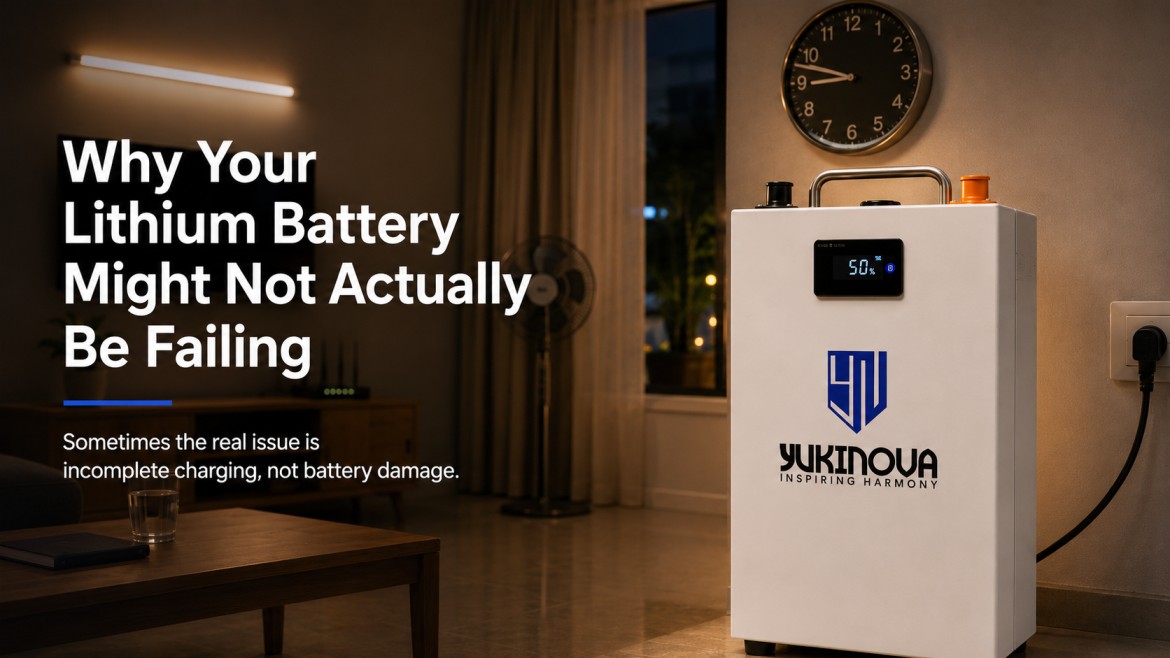
We get this call a lot: “My battery is only two years old and it’s already dying.” Someone bought a Lithium Battery for Inverter expecting years of solid backup, and now it’s cutting out an hour earlier than it used to. Nine times out of ten, when we actually go through their setup with them, the battery is fine. It’s just never getting a full charge before the next outage hits.
It’s an easy thing to miss because nothing about it looks like a fault. There’s no error code, no warning light. The battery just quietly gives you less each week.
What’s Actually Happening
Say your area gets a two-hour outage most evenings. The battery handles it without breaking a sweat — lights, fans, the router, no problem. Power comes back for an hour, maybe less, before it goes out again. Problem is, that battery needed close to two hours to recover what it just spent, not one.
So it goes into the next outage already down. Do that every day for a couple of weeks and the shortfall adds up. First you notice the backup ends ten minutes sooner than usual. Then it’s the low-battery alarm going off while you’re in the middle of something. Eventually someone in the house is turning off a fan just to keep the Wi-Fi alive a bit longer, and everyone assumes the battery is wearing out.
It’s not. It just never got caught up.
Partial Charging Isn’t the Villain Here
People sometimes worry that charging a lithium battery partway and unplugging it repeatedly will wreck it. It won’t. Lithium cells are actually pretty forgiving about partial cycles — you don’t need to hit 100% every time.
What matters is whether the charge it does get is enough for what’s coming next. Two hours of discharge followed by forty minutes of recharge isn’t a partial-charging issue, it’s a math problem. The battery is being asked to give more than the system is giving back.
Worth noting: some batteries balance their cells near the top of the charge curve, and that behavior is entirely down to the BMS and how the manufacturer designed it. If you’re not sure what your system does, check the manual rather than guess.
Half the Time, It’s the Charger
We had a customer last year convinced his brand-new battery was defective — backup kept getting worse week over week. Turned out the charger connected to his inverter was undersized for the battery’s actual capacity. It was “charging,” technically, just far too slowly to keep up with how much he was using it.
That’s more common than people think. Before you write off the battery itself, it’s worth actually looking at the charger’s voltage and current output, the condition of the terminals and cables (loose or corroded connections quietly rob you of charging current), the inverter’s charge settings, and — this is the one people skip — how much time the battery genuinely gets to charge before the power drops again.
Why Short, Frequent Cuts Are Worse Than One Long One
This surprises people: three 40-minute outages in a day are harder on your backup than one three-hour outage. After a long cut, the grid usually stays stable for hours afterward, giving the battery a real chance to catch up. With short, repeated cuts, you might only get 30-60 minutes of stable power between them — never quite enough.
The inverter will happily tell you it’s “charging” during that window. It just doesn’t tell you it hasn’t finished the job. Same principle applies whether it’s a home backup unit or a larger energy storage system battery running a shop or office — if the load consistently outpaces what’s coming back in through the grid or solar, it starts every cycle a step behind.
Don’t Judge It Off One Bad Night
Here’s the thing about incomplete charging — it never announces itself. There’s no single outage where the battery suddenly “breaks.” It’s a slow bleed: partial charge in, full discharge out, repeat, each cycle starting a little lower than the last.
So if backup felt weak last night, that one outage doesn’t tell you much on its own. What matters is the pattern over the last week or two — how often the power’s been cutting, how long it stayed up in between, and what you had running during that time.
A Bigger Price Tag Doesn’t Fix This
We talk to a lot of people comparing inverter battery price before anything else, and look, price does matter — better cells, better safety features, longer warranty, all of that’s real. But none of it solves a charger that’s too weak or an inverter that’s cutting the charge cycle short. We’ve seen premium batteries underperform cheaper ones simply because the rest of the setup wasn’t right for them.
If you’re comparing options, look at the whole picture — battery, charger, inverter, and your actual outage pattern — not just the number on the price tag. A bigger battery won’t help if nothing around it can charge it properly.
What Actually Helps
Start by just watching your own power pattern for a week or two — how long outages last, how long the gaps between them are. Then match that against what your battery, charger, and connected load can realistically handle.
If there’s a clear mismatch, a few things usually help: cutting non-essential loads during outages, correcting the inverter’s charge settings, checking terminals and cables for wear, confirming the charger is actually rated for that battery, and — if your system supports it — pulling BMS data to see what’s really going on inside.
Don’t swap out the charger or inverter just because something feels off, though. Confirm the mismatch first. If backup has dropped suddenly and sharply, that’s worth a proper look across the whole system rather than assuming the battery’s had it.
How We Think About It at Yukinova
Before we recommend anything, we want to know the actual use case. A home dealing with one predictable evening outage needs a completely different setup than a shop getting hit with short cuts all day. The charger, inverter, connected load, and recovery time between outages all have to work as a system — that’s true whether it’s a small home battery or a full energy storage system for a commercial site.
A battery’s only job, really, is to give back what it took in before the next time it’s needed. Everything else is details.
Bottom Line
If your lithium battery for inverter backup feels like it’s fading, don’t assume it’s dying — check whether it’s actually getting the time and conditions to recharge fully first. More often than not, that’s the real story, not battery wear.
FAQs
- Does partial charging damage the battery?
No, not on its own. The issue is when the partial charge it gets isn’t enough to cover the next discharge — that’s a system problem, not a battery flaw. - Why does backup keep getting worse during frequent cuts?
Because the battery isn’t getting enough time between outages to fully recover, so each one starts a bit lower than the last. - Could the charger be the real problem?
Very possibly — it’s one of the first things we check. Wrong voltage or current for the battery leads to slow, incomplete charging even though everything looks “on” and working. - Does paying more guarantee better backup?
Not by itself. We’ve seen expensive batteries underperform because of a mismatched charger or bad inverter settings — the price tag only covers part of the equation. - Can a commercial energy storage system run into the same issue?
Yes, and honestly it’s more common there — if daily usage regularly outpaces what solar or grid charging puts back, it’s the exact same problem at a bigger scale.